
Showing posts with label What the spag is that and will it kill me?. Show all posts

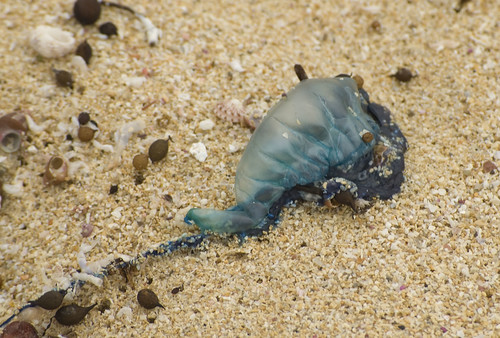
Blue Botle Jelly Fish - Man of War

DSC_0537

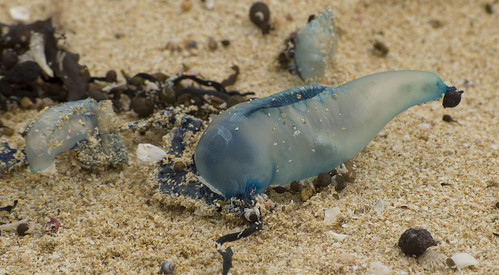
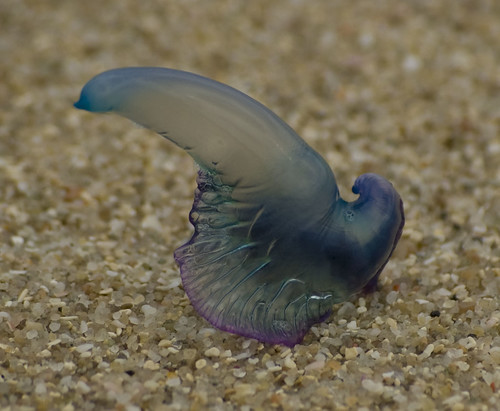
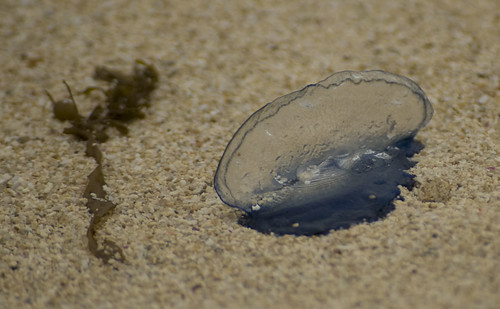
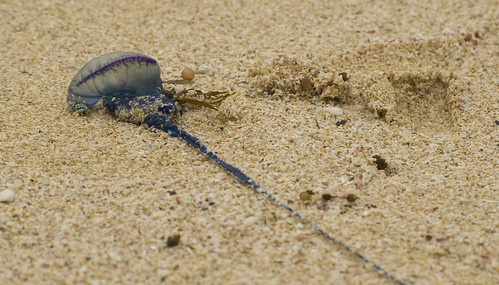
The Blue Bottle, or Portuguese Man o’ War, is a common, if unwelcome, visitor of Australian beaches. At the mercy of the wind, they are sometimes blown into shallow waters, and often wash up onto the beach. As I walked along the sands around the Margaret River area I took many a picture of these unusual jelly fish, ignorant of their identity. Although they have a bright colour some of them are quite small and their tentacles can reach up to 10 meters in length so it is easy to get caught out and stand on them on the beach.
DSC_0675

I asked a local guy, who was fishing on the beach, about the jelly fish.
“Is it OK to swim here?”
“Yeh, no worries.”
Long pause as I look at the hundreds of jelly fish washed up on the beach.
“Well what about these jelly fish, don’t they sting?”
“The Bluebottles? Yeh! They sting like a bastard, don’t touch them.”
“Do they sting you when they’re dead?”
“Yep”
“But, it’s OK to swim here?”
“Yep, just that if you get stung, you’re gonna know about it fast.” He chuckles.
DSC_0683

Although many beaches have emergency stations with vinegar for jelly fish stings, blue bottle stings are not treated with vinegar as this makes it worse. Just remove any parts still touching your skin and wash with water.
DSC_0542

Interestingly, this blue bottle is not a true jellyfish. It is actually made up of zooids and is not a single organism. Each zooid has a specific role and together they function as if it were an animal. For example a number of zooids will make up the stinging tentacles, others will make up the feeding tentacles, etcetera.
DSC_0555

The gas-filled float supports a number of specialised tentacles, which are actually members of a complicated colony.

The individual members, or ‘zooids’, cooperate to form what looks as if they are one animal-a jellyfish. Some zooids are specialised for stinging and capturing fishes and other marine animals, some are specialised for eating prey, and some are the reproductive members of the colony. Even the gas float itself is a modified colony member. In an amazing evolutionary survival too the floats are of two sorts, ones that face left and others that are angled toward the right. This means that the same wind will push the two variations in different directions, avoiding all the colonies becoming washed up on the beach and dying.
Read a cheeky bit more!

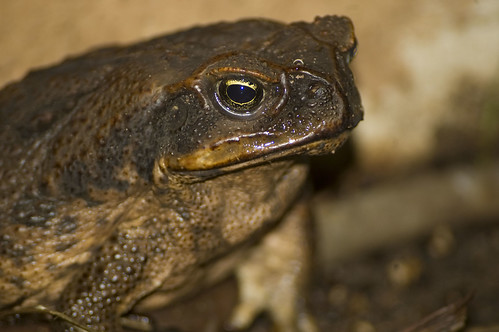
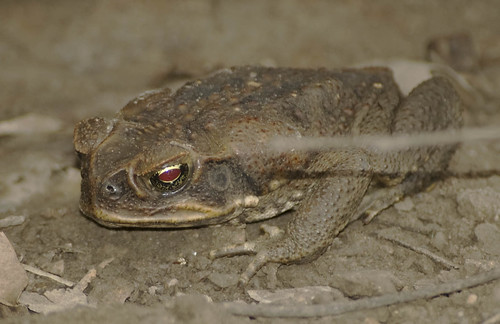
What is listed as a Class 1 drug, has a nation watching its invading front and is used to play baseball and cricket? The Cane Toad

DSC_9056

The chemical Bufotenin excreted from the glands behind the eyes of a cane toad is classified, just as heroin, as a Class 1 drug under Australian drug laws. Toad licking could result in serious illness or death and many a pet dog has fell prey to these unappetising poison bags. Apparently the toxic skin has been smoked to obtain hallucinogenic effects, but after seeing a multitude of these vulgar cretins with white puss squirting out, it is certainly not something I have ever found myself compelled to do. Pets and animals eating the creatures become sick and die and so the cane toad has become something of a national focus for hatred and disgust. Thriving in conditions where they have no natural predators, and with the ability to kill most native wildlife in Australia when ingested, this introduced species has become one of Australia’s biggest mistakes.

DSC_2768
The cane toad front is something that has been closely watched by a nation, especially farmers and nature conservationists can be watched on Australian TV after the weather. Native to Central and South America, the cane toad was introduced to Australia to help eradicate the cane beetle in 1935, the idea being they would eat all the cane beetles leaving the crops pest free without the use of pesticides. However, the cane beetles live on the top of the crops and guess what, because of its voracious and unselective appetite, the cane beetle is too fat to climb up and get them.
DSC_2759

The migration of the cane toad from its introduction area in Queensland has been rapid. As we passed through quarantine at the state boarder for Western Australia we saw signs all over advising that vehicles must be checked for cane toads. On the table by the checkpoint a fat, sorrowful pickled specimen squashed into a large yet still too small jar is on show for those who don’t know what a cane toad looks like. As I asked the boarder security guys about the cane toad they advised me that it would not be long now before the cane toad is upon them anyway, they are merely kilometres away from the check point. As it happens, we were in Western Australia a matter of days before there was a report on the evening news showing a lowly single cane toad hoping over the state boarder before it was caught and put in a jar next to the one I had asked about, the first of many to come crossing through to Western Australia.
“The impact of the cane toad, if allowed to happen, will literally destroy one of the last unique biodiversity wilderness frontiers in Australia," Lee Scott-Virtue. Kimberley Specialists in Research.


In April 2005, in an attempt to give Australian native species a fighting chance against the cane toads, Dave Tollner, a Northern Territory Member of Parliament, called for legalisation of attacking cane toads.
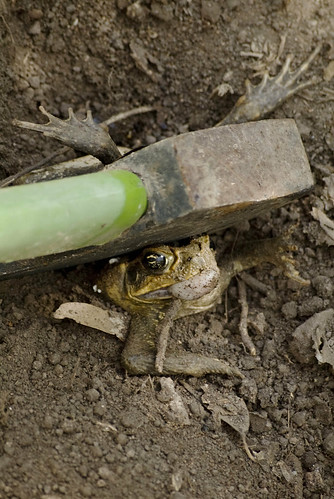
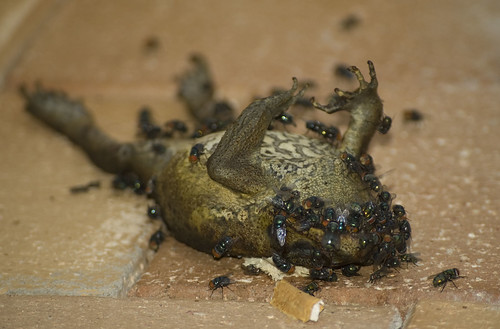
People were encouraged to kill as many as they could and even though many animal and conservation groups criticised the inhumane way of killing, I have seen detol being poured over them, cars swerving all over the road to run over those cane toads that sit on the bitumen, I have seen farmers tossing and kicking toads against walls, and I witnessed the axing of a toad in half. And in those states where the cane toad is common, and with parents positively encouraging their children to eradicate the cane toads from their gardens, some rather cruel 'sports' have developed, such as cane toad golf, baseball and cricket, where cane toads are used as balls. A bounty of 40c per toad has even been discussed in some areas. But with one adult female laying up to 20,000 eggs, and with some people telling of the toads strange ability to vomit their guts out and then swallow them back again they have so far beaten any attempts of eradication.

DSC_2081

Queensland has galvanised residents into taking part in mass culls.Townsville council encouraged people to track down and bag up the toads in an event called Toad Day Out, where live animals were taken to a collection point the following day, weighed and either frozen or gassed to death, with the carcasses turned into fertiliser.
DSC_8463

"The cane toad is probably the most disgusting creature and the most destructive creature," said Queensland politician Shane Knuth, who came up with the Toad Day Out idea. "They're killing our native wildlife, they're taking over our habitat and they're hopping all through this country." Those who criticise claim that freezing is a more humane way to kill cane toads rather than hitting them with cricket bats, but as I watched a conscientious member of the public collect dozens of toads from around his house in plastic bags and place them in a bucket, the odd plastic bag escaping the bucket, hopping off blindly around the kitchen until the fish fingers were moved over to make room in the freezer, I couldn’t help but wonder if freezing was actually any kinder at all.
Read a cheeky bit more!
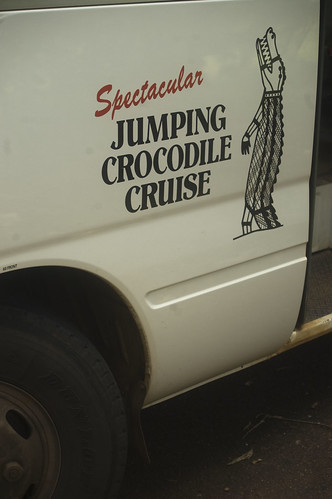
Spectacular Jumping Crocodiles, Adelaide River, Darwin

DSC_8578

Peter, owner of a Cruise company calls us during our stay in Darwin and on hearing that we were trapped there due to the floods said that we must come and see what the Adelaide river has to offer.

DSC_8600

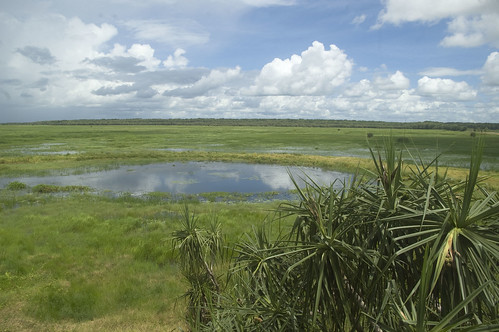
We board the pick up bus in Darwin City Centre and we head towards Jabiru, our friendly, informative driver talks away, tells us interesting tit bits of information about the things we can see to the left or the right, answering all questions thrown at him with confidence and ease. The land surrounding Darwin is lush and green, and with the wet season also comes the vast array fauna and flora, in fact, we are told that this area of the Northern Territory has more bio diversity than that of the Serengeti Plains. To see this much green and water around, especially after sleeping on the red earth of central Australia was astonishing. However, the most astonishing fact, and one which further explains our being trapped by the rains is that at one point over the last few years one part of the Adelaide river, normally 92m across expanded to engulf all surrounding land during ‘The Wet’ as it swelled to an incredible 14kms! The brief stop to the visitors centre gave us impressive aerial views of the land bellow us and offered explanations of some of the roles of the small creatures which help maintain the balance of the ecosystem.
DSC_8582

DSC_8602

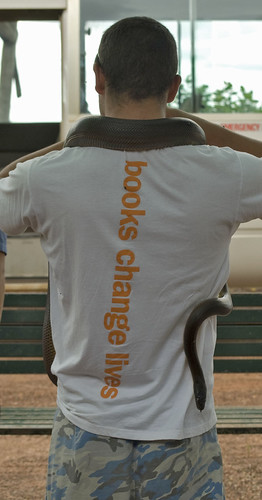
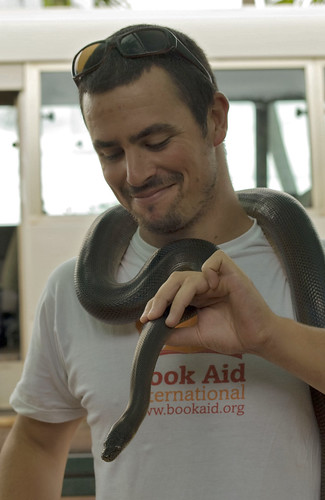
On arriving at the jetty we were greeted with a snake around our shoulders much like an Aussie version of a flower lei and we shook hands with our skipper Peter himself, who promised us something a little different.

DSC_8604

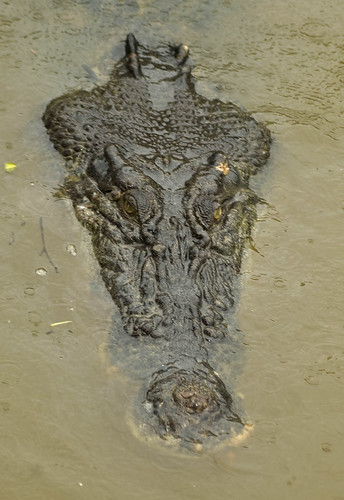
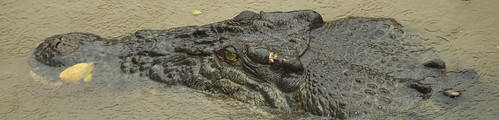
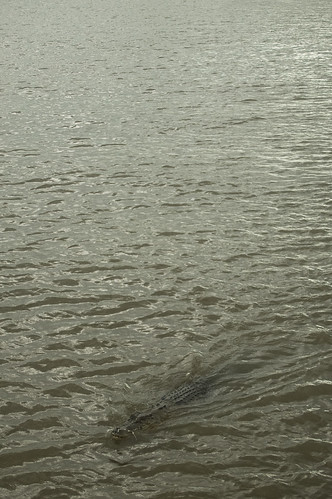
Very shortly after we set off Peter assures us that there is a croc of at least fours meters in length coming toward the boat. All the passengers quickly move to the right side of the boat, cameras at the ready, all pointing in different directions as we make wild guesses as to which ripple in the water is the croc. Eventually he has to verbally guide us to the exact location of the camouflaged killer so that our untrained eyes could focus in.

DSC_8610

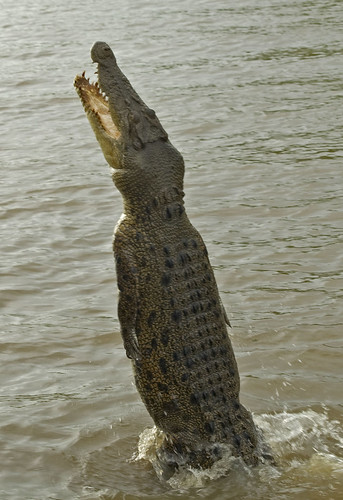
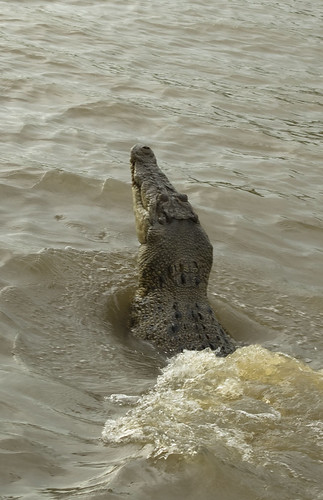
I’m leaning over the side of the boat; waiting for the shot I’ve been promised. Zoom lense ready, I’m waiting for the slight rippling of the water to give away the start of the jump. Suddenly he makes a giant, muscular, adrenalin fuelled jump. My zoom lense shows the teeth fast coming nearer to my face, he is really big.
So startled by the swift movement I jump back, recoiling from the danger, I'm too surprised to react to the impressiveness of the beast in a professional manner and completely miss the shot.
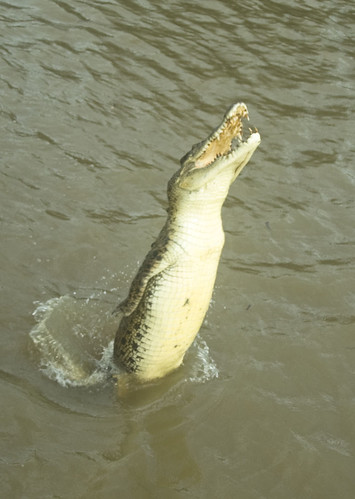
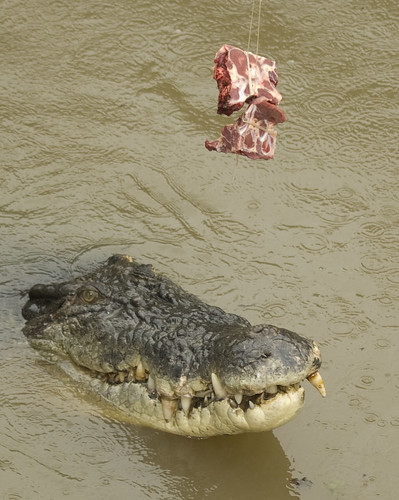
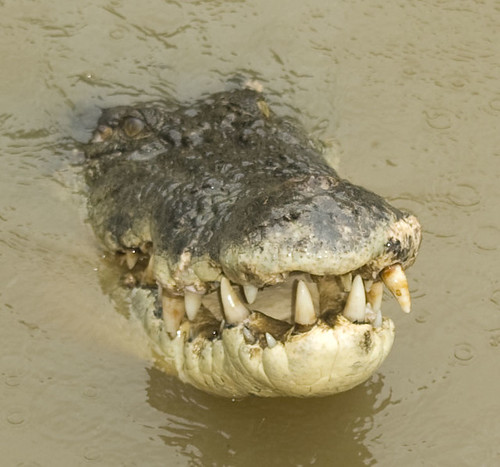
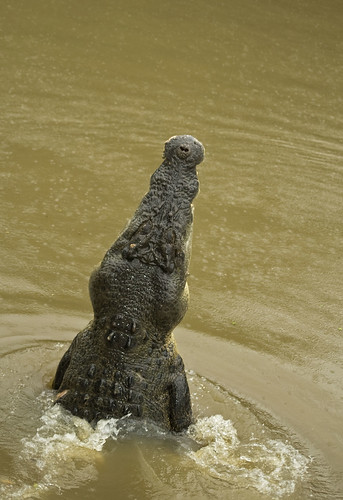
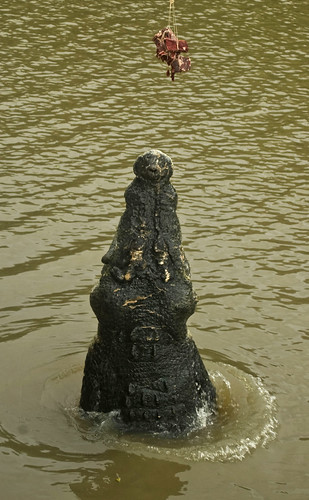
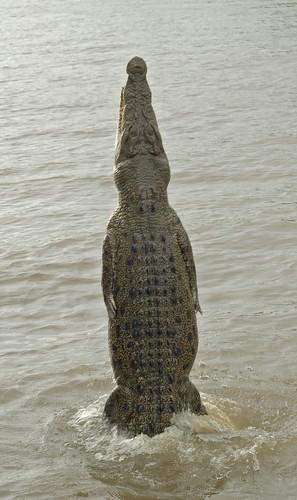
Crooked, yellow, aging teeth amongst the fresh new nashers squeezed into a powerful jaw come closer and closer and closer as the prehistoric throw back lunges out of the muddy waters, opened mouthed, toward the crowd looking over the side of the boat. Up, up, up he jumps until two thirds of his tail is completely out of the water. Nothing had quite prepared me for the sight of the crocodile lunging so far out of the water bearing all its teeth. With my eyes only just back in their sockets. My exact words of exclamation were uncouth and unrepeatable so I will lie and say I said something along the lines of “Holy Cannoli!” followed by “Wow, he sure is a big old chap, how simply awe inspiring”. He snaps at the meat on a stick which has roused him but at the very last moment it is teased out of his reach and he disappears back into the water. The lure is lowered back within reach again and he makes another spectacular jump for it, this time clamping down on the bait and swallowing it whole after landing with a splash back into the depths, camouflaged once more.

DSC_8620

DSC_8624

DSC_8628

DSC_8630

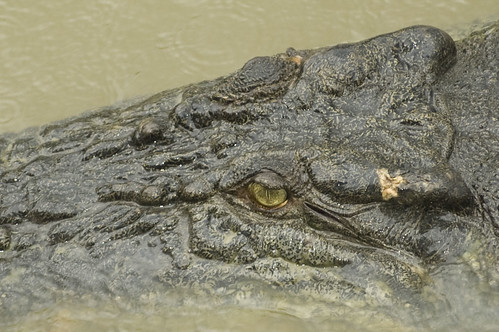
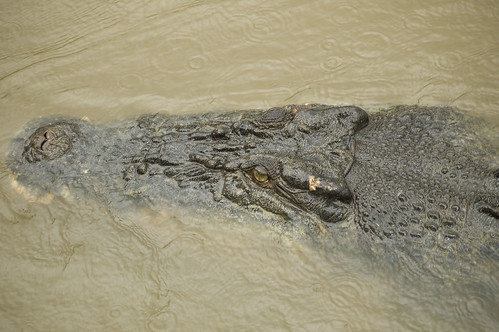
The huge specimens we see today have recently been fighting one another, fresh scars over old ones leave white marks on their heads, apparently a six meter crocodile named ‘Hannibal the Cannibal’, who has recently moved into the area has been throwing his weight around and showing the other crocs who’s boss. Powerful, age old monsters, fierce and ruthless, persistently scout the Adelaide River, learning the habits of those who venture into the waters, either to moor a boat, empty crab pots or to swim. But why would anyone with a decent sense of life saving fear go anywhere near the river? It is crawling with these man eaters. Ruthless, without sympathy or remorse they guard their territory, patrolling the turf. If you are in, or nearby the water, and they are hungry, you haven’t got a chance. You can’t appeal to their better nature and whilst Croc Dundee fans would like to believe it is possible to talk your way out of becoming dinner, the reality is that it is the croc you don’t see that will get you and you won’t ever see it’s face to get a chance to stab it in the nose with your hunting knife. We’ve seen pictures of tourist in small boats being stalked by crocs and listened to countless tales of crocs from almost everyone we meet. But, the truth is you don’t meet people with croc scars, and after seeing the big ones up close and personal, I can clearly see how it would be impossible to survive to tell the tale.

DSC_8656

DSC_8662

The news is saturated with croc stories, one day a photo of a blurred croc in the distance graces the front page, the next, descriptions of a sandal being found on the banks near where the victim was last seen, or a hat found floating down stream. Croc attacks are not as uncommon as you would hope in the Northern Territory. Since our time in Oz we have followed the reporting of a man, a father and husband, who had been taken by a crocodile whilst he was checking his crab pots. He should have known better than to put his pots out in the same place three days in a row, say some, whilst others say kill the croc. An debate on the local radio stations about what should be done causes an outcry in the outback communities who believe things should be left as they are and people should stop interfering with the natural food chain.

DSC_8672

DSC_8673

What is so misleading about the media use of the croc sightings is that they print stories of crocs as if they are a rare occurrence. The truth is that they are everywhere, Phil and I couldn’t believe how many we saw and we know for sure there was a whole bunch more hiding in the waters that were not visible to us. A croc picture on the front page sells more papers, in fact, we find out that they tend to double or triple their sales whenever our prehistoric predators grace the front cover.

DSC_8676

DSC_8677

DSC_8696

DSC_8680

Croc Facts
They can leap so that 2/3rds of their tale is out of the water
They grow new teeth as and when they are needed
They swallow stones to aid with digestion and for balance
They bask in the sun with their mouths open so their brains don’t over heat.
If croc eggs are stored below 30degrees they usually become female, if stored below they become male.
They can become really big!!!

DSC_8682

DSC_8683


DSC_8695 DSC_8646

DSC_8697

DSC_8701

DSC_8669

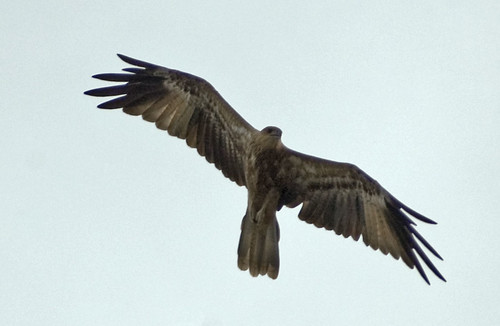
Birds of prey steal tit bits of meat as it is thrown in for the crocs


Phil and I were so thoroughly impressed with what we saw on this trip, it was something we were not expecting to ever see in the wild.

For bookings and information visit Spectacular Jumping Crocodile Cruises

DSC_8605
Read a cheeky bit more!
Huge Balls and a Double Ended Penis!!!!!

Bollocks
Look at the size of these bollocks!
Here is a little trivia for you nature lovers out there.
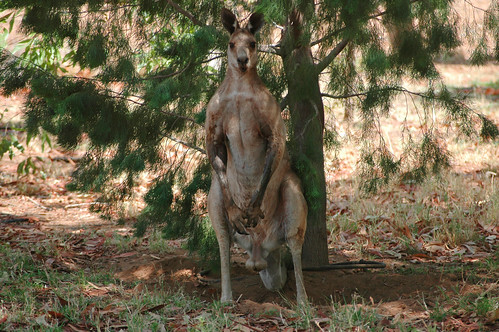
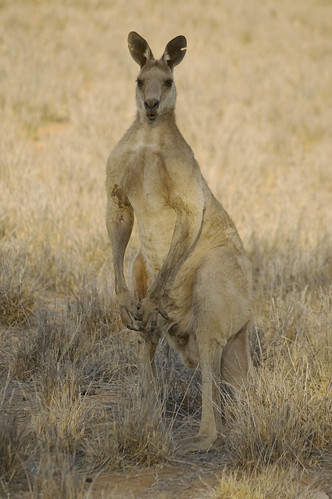
I learned before coming to Oz that kangaroos have a bifurcated johnny, which means they have two tips on their penis. Many wallabies also have a bifurcated penis, but interestingly (and I must appologise to my friend AJ with whom I had a heated debate for this), neither of the two largest species of kangaroos have this unusual feature. The males of both Grey and Red kangaroos have only one tip on their penis.
The ladies roos have three vaginas, two of which (paired lateral vaginae) lead sperm to the wombs, between them is a midline pseudovaginal canal for giving birth! So, it's one for business two for pleasure! In most marsupials, the psuedovaginal canal opens and closes with each birth. The pouch is often called the "second womb" because most of the joey's development occurs there. lon
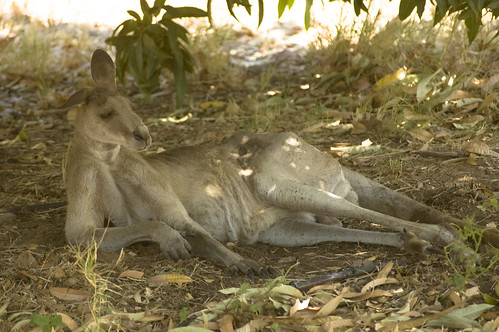
A rue lounges under the shade

The kangaroo is always pregnant, with one roo gestating as another is in the pouch.The mother can put off the gestation of the growing feotus until she has weened her first joey.
kangroo

Absolutely incredible stuff. And after getting a snapshot of a roo's balls, it's hardly surprising that they do so well and breed out of control. kangaroo done
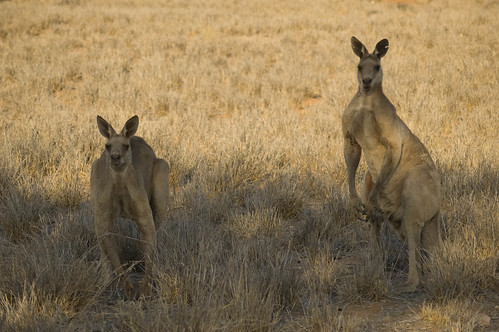
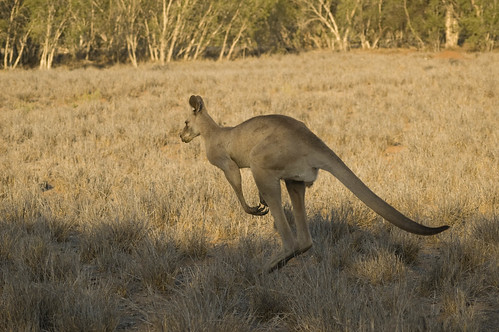
The Kangaroo population in Australia has been the one native species to flourish under the settlers occupation, with improved irrigation and waterholes providing the food and water they need to prosper. That and the fact that they are pretty hard to catch.
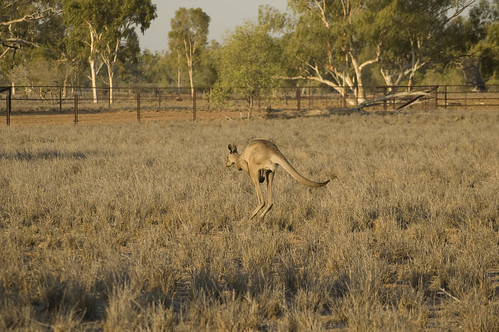
Kangaroo jumping
Kangaroo jump
For further information on our furry friends visit furry.org.au
Read a cheeky bit more!
Golden Orb Weaver Spider

DSC_2475
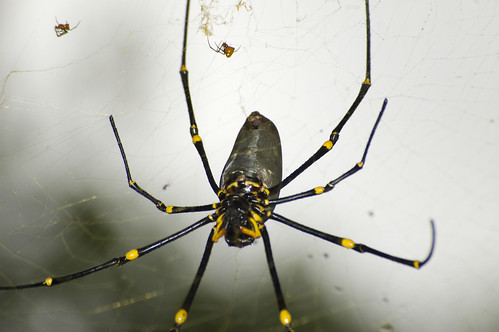
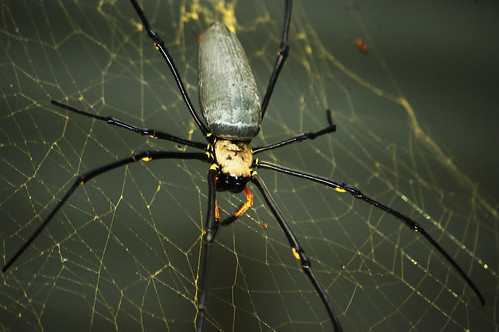
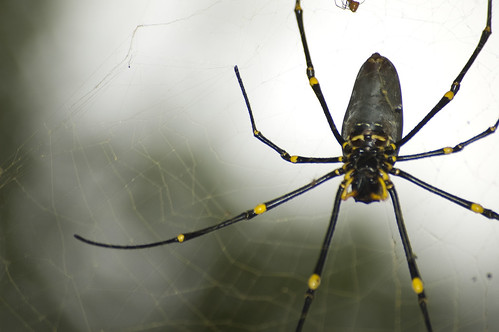
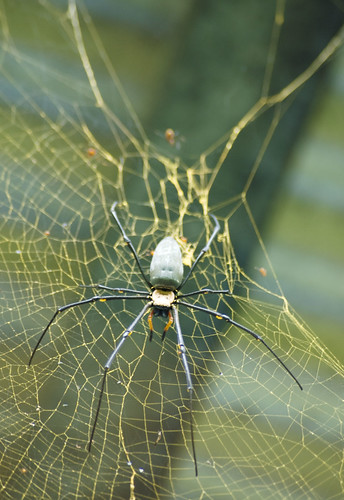
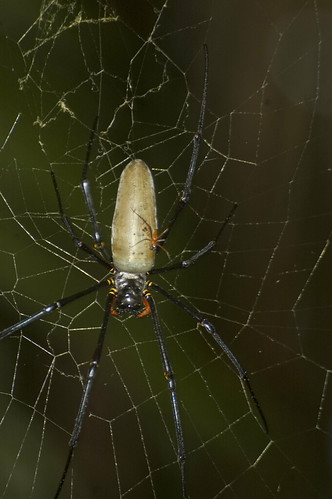
This giant spider is the Golden Orb Weaver. It is an incredible thing to see in the flesh. It's web was more than 150cm across and it is golden, which is where the spider gets it's name. If I hadn't seen it moving myself I would have taken it for a decorative giant Halloween toy.

DSC_2452

The smaller red humped spiders seen in the Golden Web spider are Silver Dew drop Argyrodes. They build no web of their own. This cheeky spider steals food from the larger host spider, sometimes from its mouth, at the risk of death.
The other small spiders in her web are the male of the species, 1000 times smaller than the giant female. The male steals food, often without her even noticing him. He lives a precarious life, stealing scraps and waiting for the female to feed at which point he creeps up and inseminates her! If he gets caught in the act, she simply eats him.

DSC_2470

The venom of the golden silk orb-weaver is potent, but not lethal to humans. Its venom is a neurotoxin similar to that of the black widow spider; however, its venom is not nearly as powerful. Its bite causes local pain, redness, and blisters, but these symptoms usually disappear within a day (though the bite mark may leave a scar)[source from Wikipedia].
DSC_2436

These spiders eat birds and after seeing them for myself I don't doubt it one bit.

DSC_9058

A female (large) with tiny male

DSC_4209

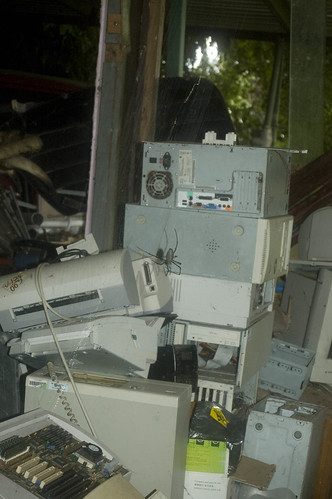
Whilst walking around someones garage I very nearly walked into this giant spider web, the spider can be seen in the middle of the junk. Read a cheeky bit more!
Ticks

DSC_7976
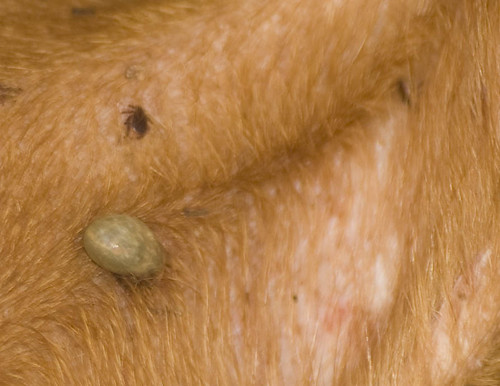
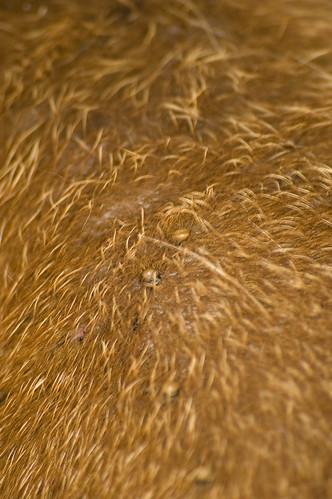
An engorged tick with it's head lodged in a dog, above it, a flat tick which is yet to feed.

Poor Gareth, the first of us to experience the awful itch of a parasite, which has lodged itself in a warm and protected area of skin. He just looked up at me and said calmly "I have a tick."
"Give me a look." I said. "No way" was the reply.
The tick had crawled into his pants and burrowed it's head into the sensitive skin in his groin. Yuk!
Phil, the good friend that he is, pulled it out with the tick removing tool we were lucky enough to have been given in a donated first aid kit.

For a few days after the invasion of Gareth's pants by the little critters I was on close watch in my own pants. Every innocent itch, brush of hair on my arm or leaf on my leg was closely followed with the 'yuk get off me' dance.

DSC_2846

The tick Gareth was introduced to would not have been a big problem but we were given a lesson on those that we do have to watch out for.
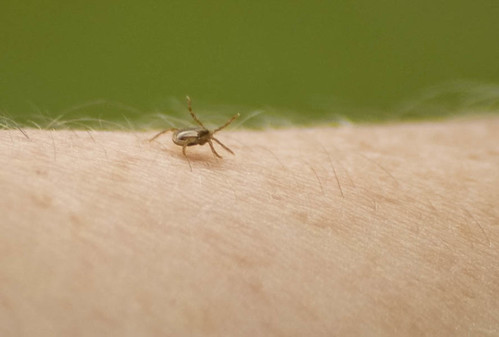
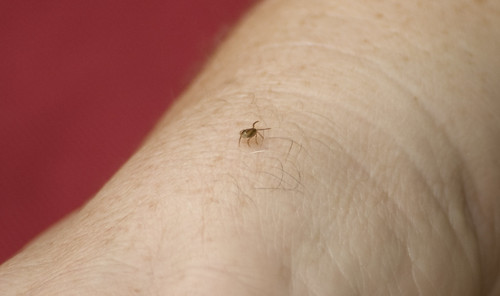
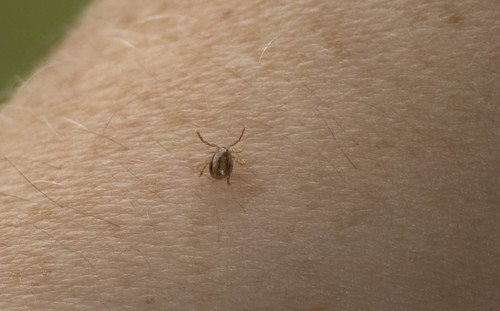
We believe the tick above is a paralysis tick. It was crawling along the arm of a friend of ours. The Paralysis Tick is found along the eastern coastline of mainland Australia. It is native to Australia and lives mainly on bandicoots, small marsupials and other warm-blooded animals. The tick has minimal effect on native animals but causes paralysis in others. It is a serious pest and can kill cattle and small domestic animals. Some human deaths have been recorded from the Paralysis Tick, mainly in young children.
The adult female can lay 2,000 to 6,000 eggs. It lays them into moist vegetation over a period of 2-5 weeks, and then dies.

DSC_2869

DSC_2853

Ticks are only 3mm-5mm but after feeding they are 1cm and can be clearly seen all over bush dogs. The unfed female has a flat shield like body but after feeding they become engorged with a bloated body.
The toxic saliva causes paralysis and allergic reactions. Removal without squeezing the body of tick is important. Fine forceps can be used to catch the head and ease it out, or the tick can be killed with pyrethroid insect repellent, which will cause it to shrivel off and die.

DSC_7973

Bush pets have to be closely taken care of. The checking of and removal of ticks becomes almost second nature to owners. There have however been a few cases where we have seen dogs and puppies absolutely covered in them from head to toe, as in the case of the poor canine above. If there isn't anyone looking out for the dogs then the infestation gets out of control. I have felt so sorry for some sad looking dogs looking for a little attention but at the same time I can't help but think about the fact that if I did find one, I would probably have to get one of the boys to get the forceps out. And wishing to think of it no further, I withdraw my outstretched hand in pat mode and say sorry to those tick ridden friends.

Read more about ticks here
Read a cheeky bit more!